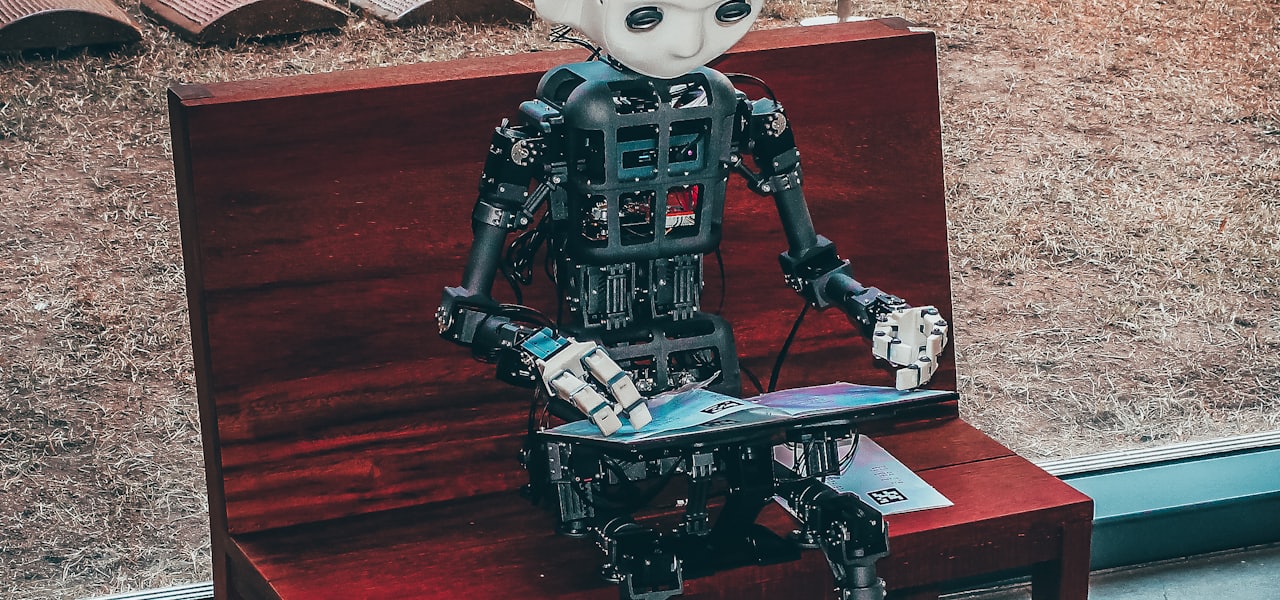
Ubiquitous robot is a term used in an analogous way to ubiquitous computing. Software useful for "integrating robotic technologies with technologies from the fields of ubiquitous and pervasive computing, sensor networks, and ambient intelligence". The emergence of mobile phone, wearable computers and ubiquitous computing makes it likely that human beings will live in a ubiquitous world in which all devices are fully networked. The existence of ubiquitous space resulting from developments in computer and network technology will provide motivations to offer desired services by any IT device at any place and time through user interactions and seamless applications. This shift has hastened the ubiquitous revolution, which has further manifested itself in the new multidisciplinary research area, ubiquitous robotics. It initiates the third generation of robotics following the first generation of the industrial robot and the second generation of the personal robot. Ubiquitous robot (Ubibot) is a robot incorporating three components including virtual software robot or avatar, real-world mobile robot and embedded sensor system in surroundings. Software robot within a virtual world can control a real-world robot as a brain and interact with human beings. Researchers of KAIST, Korea describe these three components as a Sobot (Software robot), Mobot (Mobile robot), and Embot (Embedded robot).
Symbol level
In knowledge-based systems, agents choose actions based on the principle of rationality to move closer to a desired goal. The agent is able to make decisions based on knowledge it has about the world (see knowledge level). But for the agent to actually change its state, it must use whatever means it has available. This level of description for the agent's behavior is the symbol level. The term was coined by Allen Newell in 1982. For example, in a computer program, the knowledge level consists of the information contained in its data structures that it uses to perform certain actions. The symbol level consists of the program's algorithms, the data structures themselves, and so on.
Color clock
The color clock, or color timer, is a part of the video circuitry of computer graphics hardware that works with analog color television systems. The clock is timed to match the timing of the color standard it works with, typically NTSC or PAL, ensuring that the data being read from the computer memory to create the image on-screen is in sync with the display. Depending on the speed of the color clock, the product of the resolution and number of colors is defined. Slow color clocks of many early games consoles and home computers resulted in limited color palettes at the highest resolutions.
Kinematic chain
In mechanical engineering, a kinematic chain is an assembly of rigid bodies connected by joints to provide constrained motion that is the mathematical model for a mechanical system. As the word chain suggests, the rigid bodies, or links, are constrained by their connections to other links. An example is the simple open chain formed by links connected in series, like the usual chain, which is the kinematic model for a typical robot manipulator. Mathematical models of the connections, or joints, between two links are termed kinematic pairs. Kinematic pairs model the hinged and sliding joints fundamental to robotics, often called lower pairs and the surface contact joints critical to cams and gearing, called higher pairs. These joints are generally modeled as holonomic constraints. A kinematic diagram is a schematic of the mechanical system that shows the kinematic chain. The modern use of kinematic chains includes analysis of Linkages (mechanical), compliance that arises from flexure joints in precision mechanisms, link compliance in compliant mechanisms and micro-electro-mechanical systems, and cable compliance in cable robotic and tensegrity systems. == Mobility formula == The degrees of freedom, or mobility, of a kinematic chain is the number of parameters that define the configuration of the chain. A system of n rigid bodies moving in space has 6n degrees of freedom measured relative to a fixed frame. This frame is included in the count of bodies, so that mobility does not depend on link that forms the fixed frame. This means the degree-of-freedom of this system is M = 6(N − 1), where N = n + 1 is the number of moving bodies plus the fixed body. Joints that connect bodies impose constraints. Specifically, hinges and sliders each impose five constraints and therefore remove five degrees of freedom. It is convenient to define the number of constraints c that a joint imposes in terms of the joint's freedom f, where c = 6 − f. In the case of a hinge or slider, which are one-degree-of-freedom joints, have f = 1 and therefore c = 6 − 1 = 5. The result in general where d {\displaystyle d} is the degrees of freedom for the mobility of a kinematic chain formed from n moving links and j joints each with freedom fi, i = 1, 2, …, j, is given by M = d n − ∑ i = 1 j ( d − f i ) = d ( N − 1 − j ) + ∑ i = 1 j f i {\displaystyle M=dn-\sum _{i=1}^{j}(d-f_{i})=d(N-1-j)+\sum _{i=1}^{j}f_{i}} Where N is the total number of links and includes the fixed link. Spacial linkages used d = 6 {\displaystyle d=6} and planar linkages use d = 3 {\displaystyle d=3} . This result is known as the Chebychev–Grübler–Kutzbach criterion. == Analysis of kinematic chains == The constraint equations of a kinematic chain couple the range of movement allowed at each joint to the dimensions of the links in the chain, and form algebraic equations that are solved to determine the configuration of the chain associated with specific values of input parameters, called degrees of freedom. The constraint equations for a kinematic chain are obtained using rigid transformations [Z] to characterize the relative movement allowed at each joint and separate rigid transformations [X] to define the dimensions of each link. In the case of a serial open chain, the result is a sequence of rigid transformations alternating joint and link transformations from the base of the chain to its end link, which is equated to the specified position for the end link. A chain of n links connected in series has the kinematic equations, [ T ] = [ Z 1 ] [ X 1 ] [ Z 2 ] [ X 2 ] ⋯ [ X n − 1 ] [ Z n ] , {\displaystyle [T]=[Z_{1}][X_{1}][Z_{2}][X_{2}]\cdots [X_{n-1}][Z_{n}],\!} where [T] is the transformation locating the end-link—notice that the chain includes a "zeroth" link consisting of the ground frame to which it is attached. These equations are called the forward kinematics equations of the serial chain. Kinematic chains of a wide range of complexity are analyzed by equating the kinematics equations of serial chains that form loops within the kinematic chain. These equations are often called loop equations. The complexity (in terms of calculating the forward and inverse kinematics) of the chain is determined by the following factors: Its topology: a serial chain, a parallel manipulator, a tree structure, or a graph. Its geometrical form: how are neighbouring joints spatially connected to each other? Explanation Two or more rigid bodies in space are collectively called a rigid body system. We can hinder the motion of these independent rigid bodies with kinematic constraints. Kinematic constraints are constraints between rigid bodies that result in the decrease of the degrees of freedom of rigid body system. == Synthesis of kinematic chains == The constraint equations of a kinematic chain can be used in reverse to determine the dimensions of the links from a specification of the desired movement of the system. This is termed kinematic synthesis. Perhaps the most developed formulation of kinematic synthesis is for four-bar linkages, which is known as Burmester theory. Ferdinand Freudenstein is often called the father of modern kinematics for his contributions to the kinematic synthesis of linkages beginning in the 1950s. His use of the newly developed computer to solve Freudenstein's equation became the prototype of computer-aided design systems. This work has been generalized to the synthesis of spherical and spatial mechanisms.
Touch 'n Go eWallet
Touch 'n Go eWallet is a Malaysian digital wallet and online payment platform, established in Kuala Lumpur, Malaysia, in July 2017 as a joint venture between Touch 'n Go and Ant Financial. It allows users to make payments at over 280,000 merchant touch points via QR code, as well as perform peer-to-peer (P2P) money transfers. Since then, the e-wallet further diversified for users to pay for tolls via RFID or PayDirect, street parking and various online payment spanning e-hailing, car-sharing apps or taxis, various overhead bills; top-up for mobile prepaid or in-game currencies; purchases on e-commerce websites; food delivery; renewing motor insurance and other insurance/takaful plans; and even movie, bus, trains or airline tickets. == Background == Prior to the launch of the e-wallet service, Touch 'n Go provided stored-value physical all-in-one contactless card (namely Touch 'n Go cards or "TnG cards") that users can use to pay for toll fares, public transportation and parking lots as well as purchases in some retail stores. In 1999, Touch 'n Go also markets SmartTag devices that allow road users to pass through certain toll booths without the need to unwind the car window. The high entry cost of the device (around RM 100 each) also meant that only few can enjoy the seamless experience. In 2009, Touch 'n Go partnered with Maxis to launch FastTap, a new mobile payment service that utilised Near-Field Communication (NFC). Maxis customers can make payments by placing the phone near the card readers (that also supports physical bank cards and Touch ’N Go cards). However, the venture featured only one phone model, Nokia 6212, which greatly limited the public reach. In July 2012, Touch 'n Go announced another collaboration with CIMB and Maxis to create similar NFC-based online transaction service that runs on compatible smartphones. Touch 'n Go Wallet was launched in February 2017 as an QR code-based e-wallet application, to compete with Samsung Pay that utilizes NFC modules. In the controlled pilot test in Taman Tun Dr Ismail, the correspondents can experience basic functionalities (prepaid mobile service reload, bills payment, movie tickets and flight tickets purchase, transfer of money with another user, and payments at participating stores and restaurants). While the deployed version of the app was generally well-received, the existing process to transfer the balance to the physical TnG card stored value from the app garnered unanimous backlash. Test groups felt that the need to head to a self-service terminal named "Pick Up Device" in person within 24 hours for completion, along with the failure to do so (the balance would be credited back to the wallet after 24 hours), was not divulged clearly and also defeated the purpose of convenience, not to mention there were only 2 such terminals. The feature was eventually suspended. On 15 November 2017, Touch 'n Go was granted permission by the Central Bank of Malaysia to form a joint venture with Ant Financial, a Chinese-based financial company that operates Alipay. The partnership allowed the local e-wallet to learn from and build upon the operational model pioneered by Alipay. In June 2018, it was reported that Touch 'n Go was pilot testing the uses of the Touch 'n Go eWallet in Rapid Transit, as the ticketing system was enabled on the Kelana Jaya line in the Klang Valley. Pilot testing only applied to stations in Kelana Jaya, KL Gateway–Universiti, Kerinchi, KL Sentral, Dang Wangi, KLCC, and Ampang Park. The test was reported to be successful in February 2020 and was planned to be fully deployed on the LRT and MRT. Due to unforeseen circumstances, this feature did not come into fruition, the app merely adds in-app purchase of monthly concession cards called "My50". In August 2018, Touch 'n Go announced that selected drivers may experience first-hand a new RFID-based payment (later rebranded as "myRFID") that serves to replace SmartTag devices on closed toll roads with during pilot testing phase commencing on 3 September 2018. On 2 November 2018, participation in the ongoing pilot programme was expanded, allowing more drivers to sign up ahead of the public rollout of the RFID system. During the same period, Touch 'n Go has discontinued the sales of SmartTAG devices in favor of the RFID-based payment system. Initially, the installation of the RFID chip onto the car could only be done by Touch 'n Go staff at the RFID fitment centers, at no cost. As the pilot testing concluded on 15 February 2020, a self-installation kit are being offered to the public on Lazada and Shopee. Support for taxi-hailing mobile apps was added in November 2018 when Touch 'n Go partnered with EzCab and Public Cab, allowing users to make payments via QR code. This was later expanded to support MULA on 7 January 2020, and later MyCar on 4 April 2020. Touch 'n Go eWallet was also the first eWallet to convert Kuala Lumpur's most famous Ramadan bazaar in Kampong Bahru into "Kampong Kashless", a venue that can accept cashless QR payments. It welcomed more than 250,000 Malaysians including local celebrities and government officials. On 1 October 2019, some e-commerce websites owned by the Alibaba Group (TMall and Taobao) began to support Touch 'n Go eWallet payments, Lazada joined the list on 29 October 2019. Touch 'n Go eWallet was one of the three e-wallet services in Malaysia (the other being Boost and GrabPay) that was eligible for its users to receive an RM 30 credit in conjunction of E-Tunai Rakyat program under the Budget 2020 plan, that further normalizes adoption of cashless and mobile payment among Malaysians. Unlike Boost and GrabPay, whose P2P transfers were completely disabled until users have exhausted the RM 30 first, Touch 'n Go eWallet did not impose such measures. in 2020, Touch 'n Go eWallet joined DuitNow, an electronic transaction ecosystem in Malaysia which allows the funds from Touch 'n Go eWallet to be transferred to other competing services and vice versa, by implementing a standard DuitNow QR code deisgn. Japan become the first country outside Malaysia to support Touch 'n Go eWallet payment via Alipay Connect. During the COVID-19 pandemic and the enforcement of the movement control order, use of eWallets (including Touch 'n Go eWallet) increased tremendously among citizens due to its contactless nature of the payment and increased take-out orders at home; which in turn helped small and medium-sized enterprises to thrive. Touch 'n Go eWallet launched its loyalty programme – The Goal Hunter – in October 2020 where on monthly basis, users collect stamps by paying with the app in exchange for rewards that include lucky draws and other vouchers. == Services == Touch 'n Go eWallet app is available for download on both Google Play and Apple Appstore. It utilizes QR code technology for local in-store payments. The Touch 'n Go eWallet app also diversifies payment types, including but not limited to Utility bills Purchase of motor insurance policy Pay Later facility Prepaid reload and Postpaid payment to telecommunications companies loan repayments for courts, MBSJ payments, zakat and PTPTN payment for car parking P2P transfer airline ticket bookings; movie tickets from TGV Cinemas RFID refuelling at Shell stations (defunct after Shell launched its own payment app in 2024) User can reload the eWallet credit by setting up auto-reload, purchasing reload pins from convenience stores (such as 7-Eleven, KK Super Mart, MyNews, Family Mart etc.), reloading by FPX and credit/debit card. The PayDirect feature allows users to link their physical Touch 'n Go cards into the eWallet, where the toll fare can be debited from the eWallet balance when flashing the card near the sensor. In the circumstance of insufficient balance in the app, the toll fare will be deducted from the physical card's balance instead. This also conveniently allows users to view the card's remaining balance. Touch 'n Go eWallet is the first and only eWallet to offer a money-back guarantee when an unauthorised transaction is made on the user’s eWallet account, subject to Terms & Conditions. Payment via QR code scanning, including Touch 'n Go eWallet, becomes a norm in most of the shops/restaurants across Malaysia, including roadside hawkers/stall owners and automatic vending machines. The merchants usually display their owner's individual QR or Business account that they can apply for in-app. The popularity attributes to the low merchant onboarding cost (Unlike NFC payment and debit/credit card that requires purchase or rental of a payment terminal device at a yearly fee.) The app is also one of the few ewallet that supports bidirectional liquidity (alongside MAE developed by Maybank), where funds can be transferred two-way with bank accounts. This is not possible with the other major ewallets (GrabPay, Boost, ShopeePay etc.) where the money that is reloaded to the wallet cannot be transferred to another bank account, unless through manual req
Pixel aspect ratio
A pixel aspect ratio (PAR) is a mathematical ratio that describes how the width of a pixel in a digital image compares to the height of that pixel. Most digital imaging systems display an image as a grid of tiny, square pixels. However, some imaging systems, especially those that must be compatible with standard-definition television motion pictures, display an image as a grid of rectangular pixels, in which the pixel width and height are different. Pixel aspect ratio describes this difference. Use of pixel aspect ratio mostly involves pictures pertaining to standard-definition television and some other exceptional cases. Most other imaging systems, including those that comply with SMPTE standards and practices, use square pixels. PAR is also known as sample aspect ratio and abbreviated SAR, though it can be confused with storage aspect ratio. == Introduction == The ratio of the width to the height of an image is known as the aspect ratio, or more precisely the display aspect ratio (DAR) – the aspect ratio of the image as displayed; for TV, DAR was traditionally 4:3 (a.k.a. fullscreen), with 16:9 (a.k.a. widescreen) now the standard for HDTV. In digital images, there is a distinction with the storage aspect ratio (SAR), which is the ratio of pixel dimensions. If an image is displayed with square pixels, then these ratios agree; if not, then non-square, "rectangular" pixels are used, and these ratios disagree. The aspect ratio of the pixels themselves is known as the pixel aspect ratio (PAR) – for square pixels this is 1:1 – and these are related by the identity: Rearranging (solving for PAR) yields: For example: A 640 × 480 VGA image has a SAR of 640/480 = 4:3, and if displayed on a 4:3 display (DAR = 4:3) has square pixels, hence a PAR of 1:1. By contrast, a 720 × 576 D-1 PAL image has a SAR of 720/576 = 5:4, but if displayed on a 4:3 display (DAR = 4:3) the PAR is 4/3 : 5/4 = 16:15 ≈ 1.066. This means that the pixels of the PAL picture must be "stretched" by this amount to fit in the 4:3 display. In analog images such as film there is no notion of pixel, nor notion of SAR or PAR, but in the digitization of analog images the resulting digital image has pixels, hence SAR (and accordingly PAR, if displayed at the same aspect ratio as the original). Non-square pixels arise often in early digital TV standards, related to digitalization of analog TV signals – whose vertical and "effective" horizontal resolutions differ and are thus best described by non-square pixels – and also in some digital video cameras and computer display modes, such as Color Graphics Adapter (CGA). Today they arise also in transcoding between resolutions with different SARs. Actual displays do not generally have non-square pixels, though digital sensors might; they are rather a mathematical abstraction used in resampling images to convert between resolutions. There are several complicating factors in understanding PAR, particularly as it pertains to digitization of analog video: First, analog video does not have pixels, but rather a raster scan, and thus has a well-defined vertical resolution (the lines of the raster), but not a well-defined horizontal resolution, since each line is an analog signal. However, by a standardized sampling rate, the effective horizontal resolution can be determined by the sampling theorem, as is done below. Second, due to overscan, some of the lines at the top and bottom of the raster are not visible, as are some of the possible image on the left and right – see Overscan: Analog to digital resolution issues. Also, the resolution may be rounded (DV NTSC uses 480 lines, rather than the 486 that are possible). Third, analog video signals are interlaced – each image (frame) is sent as two "fields", each with half the lines. Thus either the pixels are twice as tall as they would be without interlacing, or the image is deinterlaced. == Background == Video is presented as a sequential series of images called video frames. Historically, video frames were created and recorded in analog form. As digital display technology, digital broadcast technology, and digital video compression evolved separately, it resulted in video frame differences that must be addressed using pixel aspect ratio. Digital video frames are generally defined as a grid of pixels used to present each sequential image. The horizontal component is defined by pixels (or samples), and is known as a video line. The vertical component is defined by the number of lines, as in 480 lines. Standard-definition television standards and practices were developed as broadcast technologies and intended for terrestrial broadcasting, and were therefore not designed for digital video presentation. Such standards define an image as an array of well-defined horizontal "Lines", well-defined vertical "Line Duration" and a well-defined picture center. However, there is not a standard-definition television standard that properly defines image edges or explicitly demands a certain number of picture elements per line. Furthermore, analog video systems such as NTSC 480i and PAL 576i, instead of employing progressively displayed frames, employ fields or interlaced half-frames displayed in an interwoven manner to reduce flicker and double the image rate for smoother motion. === Analog-to-digital conversion === As a result of computers becoming powerful enough to serve as video editing tools, video digital-to-analog converters and analog-to-digital converters were made to overcome this incompatibility. To convert analog video lines into a series of square pixels, the industry adopted a default sampling rate at which luma values were extracted into pixels. The luma sampling rate for 480i pictures was 12+3⁄11 MHz and for 576i pictures was 14+3⁄4 MHz. The term pixel aspect ratio was first coined when ITU-R BT.601 (commonly known as Rec. 601) specified that standard-definition television pictures are made of lines of exactly 720 non-square pixels. ITU-R BT.601 did not define the exact pixel aspect ratio but did provide enough information to calculate the exact pixel aspect ratio based on industry practices: The standard luma sampling rate of precisely 13+1⁄2 MHz. Based on this information: The pixel aspect ratio for 480i would be 10:11 as: 12 3 11 ÷ 13 1 2 = 10 11 {\displaystyle 12{\tfrac {3}{11}}\div 13{\tfrac {1}{2}}={\tfrac {10}{11}}} The pixel aspect ratio for 576i would be 59:54 as: 14 3 4 ÷ 13 1 2 = 59 54 {\displaystyle 14{\tfrac {3}{4}}\div 13{\tfrac {1}{2}}={\tfrac {59}{54}}} SMPTE RP 187 further attempted to standardize the pixel aspect ratio values for 480i and 576i. It designated 177:160 for 480i or 1035:1132 for 576i. However, due to significant difference with practices in effect by industry and the computational load that they imposed upon the involved hardware, SMPTE RP 187 was simply ignored. SMPTE RP 187 information annex A.4 further suggested the use of 10:11 for 480i. As of this writing, ITU-R BT.601-6, which is the latest edition of ITU-R BT.601, still implies that the pixel aspect ratios mentioned above are correct. === Digital video processing === As stated above, ITU-R BT.601 specified that standard-definition television pictures are made of lines of 720 non-square pixels, sampled with a precisely specified sampling rate. A simple mathematical calculation reveals that a 704 pixel width would be enough to contain a 480i or 576i standard 4:3 picture: A 4:3 480-line picture, digitized with the Rec. 601-recommended sampling rate, would be 704 non-square pixels wide. x 480 × 10 11 = 4 3 ⇒ x = 480 × 11 × 4 10 × 3 = 704 {\displaystyle {\frac {x}{480}}\times {\frac {10}{11}}={\frac {4}{3}}\Rightarrow x={\frac {480\times 11\times 4}{10\times 3}}=704} A 4:3 576-line picture, digitized with the Rec. 601-recommended sampling rate, would be 702+54⁄59 non-square pixels wide. x 576 × 59 54 = 4 3 ⇒ x = 576 × 54 × 4 59 × 3 = 702 54 59 {\displaystyle {\frac {x}{576}}\times {\frac {59}{54}}={\frac {4}{3}}\Rightarrow x={\frac {576\times 54\times 4}{59\times 3}}=702{\tfrac {54}{59}}} Unfortunately, not all standard TV pictures are exactly 4:3: As mentioned earlier, in analog video, the center of a picture is well-defined but the edges of the picture are not standardized. As a result, some analog devices (mostly PAL devices but also some NTSC devices) generated motion pictures that were horizontally (slightly) wider. This also proportionately applies to anamorphic widescreen (16:9) pictures. Therefore, to maintain a safe margin of error, ITU-R BT.601 required sampling 16 more non-square pixels per line (8 more at each edge) to ensure saving all video data near the margins. This requirement, however, had implications for PAL motion pictures. PAL pixel aspect ratios for standard (4:3) and anamorphic wide screen (16:9), respectively 59:54 and 118:81, were awkward for digital image processing, especially for mixing PAL and NTSC video clips. Therefore, video editing products chose the almost equivalent value
Truth discovery
Truth discovery (also known as truth finding) is the process of choosing the actual true value for a data item when different data sources provide conflicting information on it. Several algorithms have been proposed to tackle this problem, ranging from simple methods like majority voting to more complex ones able to estimate the trustworthiness of data sources. Truth discovery problems can be divided into two sub-classes: single-truth and multi-truth. In the first case only one true value is allowed for a data item (e.g birthday of a person, capital city of a country). While in the second case multiple true values are allowed (e.g. cast of a movie, authors of a book). Typically, truth discovery is the last step of a data integration pipeline, when the schemas of different data sources have been unified and the records referring to the same data item have been detected. == General principles == The abundance of data available on the web makes more and more probable to find that different sources provide (partially or completely) different values for the same data item. This, together with the fact that we are increasing our reliance on data to derive important decisions, motivates the need of developing good truth discovery algorithms. Many currently available methods rely on a voting strategy to define the true value of a data item. Nevertheless, recent studies, have shown that, if we rely only on majority voting, we could get wrong results even in 30% of the data items. The solution to this problem is to assess the trustworthiness of the sources and give more importance to votes coming from trusted sources. Ideally, supervised learning techniques could be exploited to assign a reliability score to sources after hand-crafted labeling of the provided values; unfortunately, this is not feasible since the number of needed labeled examples should be proportional to the number of sources, and in many applications the number of sources can be prohibitive. == Single-truth vs multi-truth discovery == Single-truth and multi-truth discovery are two very different problems. Single-truth discovery is characterized by the following properties: only one true value is allowed for each data item; different values provided for a given data item oppose to each other; values and sources can either be correct or erroneous. While in the multi-truth case the following properties hold: the truth is composed by a set of values; different values could provide a partial truth; claiming one value for a given data item does not imply opposing to all the other values; the number of true values for each data item is not known a priori. Multi-truth discovery has unique features that make the problem more complex and should be taken into consideration when developing truth-discovery solutions. The examples below point out the main differences of the two methods. Knowing that in both examples the truth is provided by source 1, in the single truth case (first table) we can say that sources 2 and 3 oppose to the truth and as a result provide wrong values. On the other hand, in the second case (second table), sources 2 and 3 are neither correct nor erroneous, they instead provide a subset of the true values and at the same time they do not oppose the truth. == Source trustworthiness == The vast majority of truth discovery methods are based on a voting approach: each source votes for a value of a certain data item and, at the end, the value with the highest vote is select as the true one. In the more sophisticated methods, votes do not have the same weight for all the data sources, more importance is indeed given to votes coming from trusted sources. Source trustworthiness usually is not known a priori but estimated with an iterative approach. At each step of the truth discovery algorithm the trustworthiness score of each data source is refined, improving the assessment of the true values that in turn leads to a better estimation of the trustworthiness of the sources. This process usually ends when all the values reach a convergence state. Source trustworthiness can be based on different metrics, such as accuracy of provided values, copying values from other sources and domain coverage. Detecting copying behaviors is very important, in fact, copy allows to spread false values easily making truth discovery very hard, since many sources would vote for the wrong values. Usually systems decrease the weight of votes associated to copied values or even don’t count them at all. == Single-truth methods == Most of the currently available truth discovery methods have been designed to work well only in the single-truth case. Below are reported some of the characteristics of the most relevant typologies of single-truth methods and how different systems model source trustworthiness. === Majority voting === Majority voting is the simplest method, the most popular value is selected as the true one. Majority voting is commonly used as a baseline when assessing the performances of more complex methods. === Web-link based === These methods estimate source trustworthiness exploiting a similar technique to the one used to measure authority of web pages based on web links. The vote assigned to a value is computed as the sum of the trustworthiness of the sources that provide that particular value, while the trustworthiness of a source is computed as the sum of the votes assigned to the values that the source provides. === Information-retrieval based === These methods estimate source trustworthiness using similarity measures typically used in information retrieval. Source trustworthiness is computed as the cosine similarity (or other similarity measures) between the set of values provided by the source and the set of values considered true (either selected in a probabilistic way or obtained from a ground truth). === Bayesian based === These methods use Bayesian inference to define the probability of a value being true conditioned on the values provided by all the sources. P ( v ∣ ψ ( o ) ) = P ( ψ ( o ) ∣ v ) ⋅ P ( v ) P ( ψ ( o ) ) {\displaystyle P(v\mid \psi (o))={\frac {P(\psi (o)\mid v)\cdot P(v)}{P(\psi (o))}}} where v {\displaystyle \textstyle v} is a value provided for a data item o {\displaystyle \textstyle o} and ψ ( o ) {\displaystyle \textstyle \psi (o)} is the set of the observed values provided by all the sources for that specific data item. The trustworthiness of a source is then computed based on the accuracy of the values that provides. Other more complex methods exploit Bayesian inference to detect copying behaviors and use these insights to better assess source trustworthiness. == Multi-truth methods == Due to its complexity, less attention has been devoted to the study of the multi-truth discovery Below are reported two typologies of multi-truth methods and their characteristics. === Bayesian based === These methods use Bayesian inference to define the probability of a group of values being true conditioned on the values provided by all the data sources. In this case, since there could be multiple true values for each data item, and sources can provide multiple values for a single data item, it is not possible to consider values individually. An alternative is to consider mappings and relations between set of provided values and sources providing them. The trustworthiness of a source is then computed based on the accuracy of the values that provides. More sophisticated methods also consider domain coverage and copying behaviors to better estimate source trustworthiness. === Probabilistic Graphical Models based === These methods use probabilistic graphical models to automatically define the set of true values of given data item and also to assess source quality without need of any supervision. == Applications == Many real-world applications can benefit from the use of truth discovery algorithms. Typical domains of application include: healthcare, crowd/social sensing, crowdsourcing aggregation, information extraction and knowledge base construction. Truth discovery algorithms could be also used to revolutionize the way in which web pages are ranked in search engines, going from current methods based on link analysis like PageRank, to procedures that rank web pages based on the accuracy of the information they provide.